
Full Mouth Rehabilitation Case Study:
With All-on-6 and Lower Crowns
The Challenge
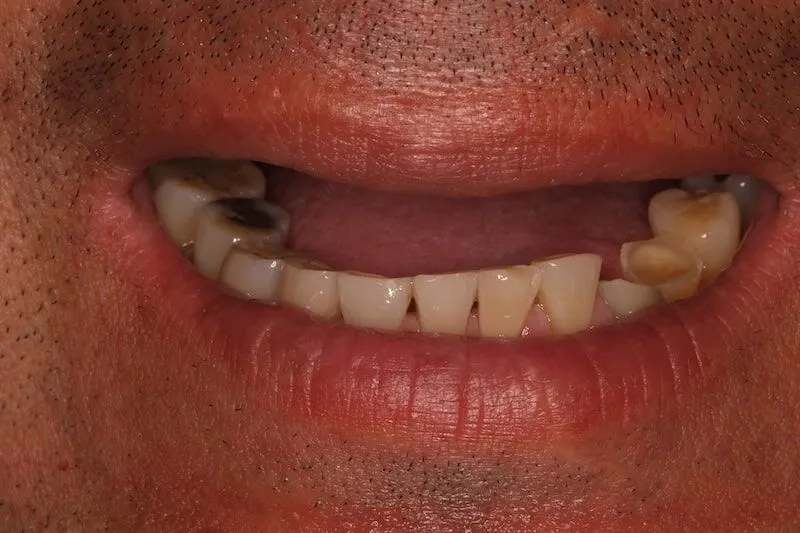
This patient was deeply concerned about the functionality of his mouth. He experienced severe wear on his upper teeth, was unable to chew properly, and suffered from significant tooth sensitivity.
For years, he avoided smiling because he felt self-conscious about the appearance of his teeth.
The Solution
We conducted a comprehensive diagnostic process, including a CT scan, intraoral scan, full set of photographs, clinical examination, and complete medical and dental history.
Our evaluation revealed that the severe wear was caused by a combination of jaw positioning issues and advanced bruxism.
We determined that:
The lower teeth, although worn, were still healthy and could be restored with crowns.
The upper jaw, with multiple missing and severely damaged teeth, required a full arch implant solution.
We proposed an All-on-6 procedure to reestablish proper bite function and provide long-term stability.
First Visit
During the first appointment:
The few remaining upper teeth were extracted.
Six dental implants were placed to support the future All-on-6 restoration.
A temporary upper denture was delivered for use during the healing phase.
The patient was informed that a healing period of approximately six months would be necessary before completing the final restoration.
Second Visit
After six months, the implants were uncovered to take final impressions for the All-on-6 restoration.
We also:
Prepared the lower teeth for crowns.
Took final digital impressions.
Verified functionality and comfort using a temporary set of teeth.
We then met with our laboratory technicians and the patient to choose all aesthetic details—color, shape, texture, and overall design—for both the upper All-on-6 and the lower crowns.
The Result
One week later, the patient returned for approval of the final restorations.
Everything matched perfectly thanks to thorough planning, so we proceeded with the delivery:
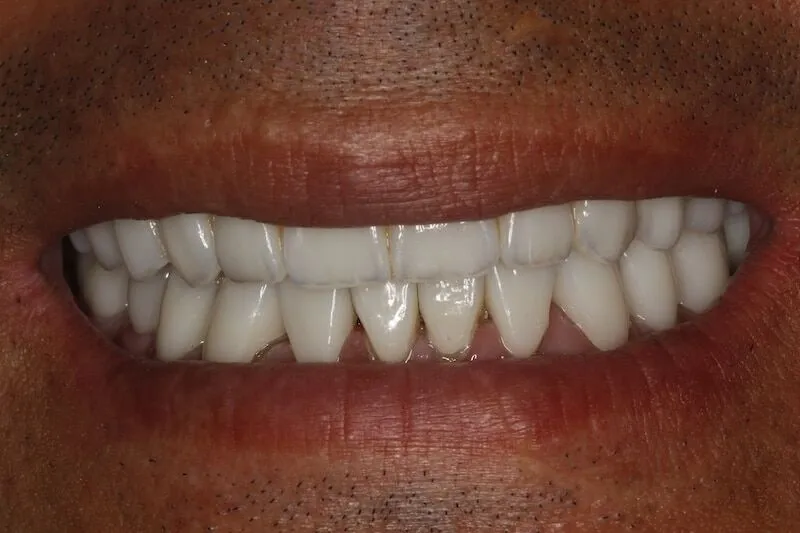
The All-on-6 prosthesis and lower crowns were installed.
The bite was carefully adjusted.
The patient was instructed to test the restorations in real-life conditions.
At the follow-up visit the next day, final adjustments were made, and the patient received a custom night guard to protect his new smile.
A panoramic X-ray and final set of photos were taken to document the results.
The Outcome
The transformation was remarkable.
The patient regained proper chewing function, eliminated sensitivity, and—after years of hiding his smile—finally felt confident again.
The results truly speak for themselves.